tinhuviel: (Triskele)

As I was growing up in Asheville, I'd spend a great deal of time with my great-grandmother, Little Granny (she was 4'10"). Here's a picture of her mother, Granny Mehaffey, who was born on September 9, 1867, and fought a bobcat to the death in her 30s.  If I remember correctly, she was in her 90s when she died, and she had one tooth her head that she would use to eat apples! It's true that the Scots-Irish folk of the mountains are tough as goddamned nails. Nowadays, I'm thinking she would have to go a bit further into the Blue Ridge Mountains in order to be fully understood, since a lot of the language has faded over the decades. Granny Mehaffey probably sounded more like she was speaking a bastard version of Gaelic and German than the modern Appalachian dialect of today. Here are some words I used to hear her use, and some I even have used myself throughout my life. Those I've put in bold.

  • Afeared - afraid
  • Ary - any
  • Bald - a treeless mountain summit
  • Blinds - window shades
  • Blinked or Blinky - gone sour, usually in reference to milk
  • Brickle - brittle (Little Granny always called peanut brittle "brickle".
  • Cat-head - a giant ass biscuit
  • Clean - used as an adverb meaning "all the way."  "I'll knock your damn head clean off your shoulders!"
  • Coke - any cola, be it Coca-Cola, Pepsi, or RC.
  • Cornpone - cornbread (I had a dog named Cornpone!)
  • Directly - soon, later, after a while, when it's convenient.  "I'll call you back die-RECK-lee."
  • Fit - fought, as in (and I'm not lying here) "I'm so tired, I feel like I fit fire (pronounced far) all day."
  • Haint - ghost, spirit, hideous woman
  • Holler - for hollow, the valley in between mountains
  • Hull - shell, as in a nut hull.
  • Ill - bad-tempered
  • Jarfly - cicada
  • Kyarn - carrion.  Anything that smells rotten.
  • Lay out - to skip school or work
  • Meeting - religious service, as in "Sunday-go-to-meetin'"
  • Nary - none
  • Peckerwood - someone you think is an asshole.
  • Piece - distance, as in, "You'll find the gas station up the road a piece."
  • Plum - completely.  "I'm plum wore out!"
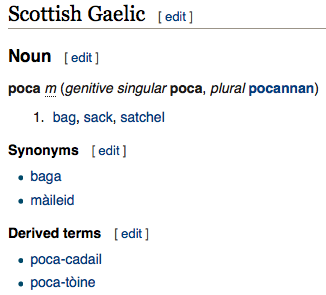
  • Poke - satchel (see its origins for real and true. ----->)
  • Poke sallet - a salad made from the boiled leaves of the poke bush.
  • Quare - queer, as in the original meaning of the word, which was strange.
  • Reckon - suppose
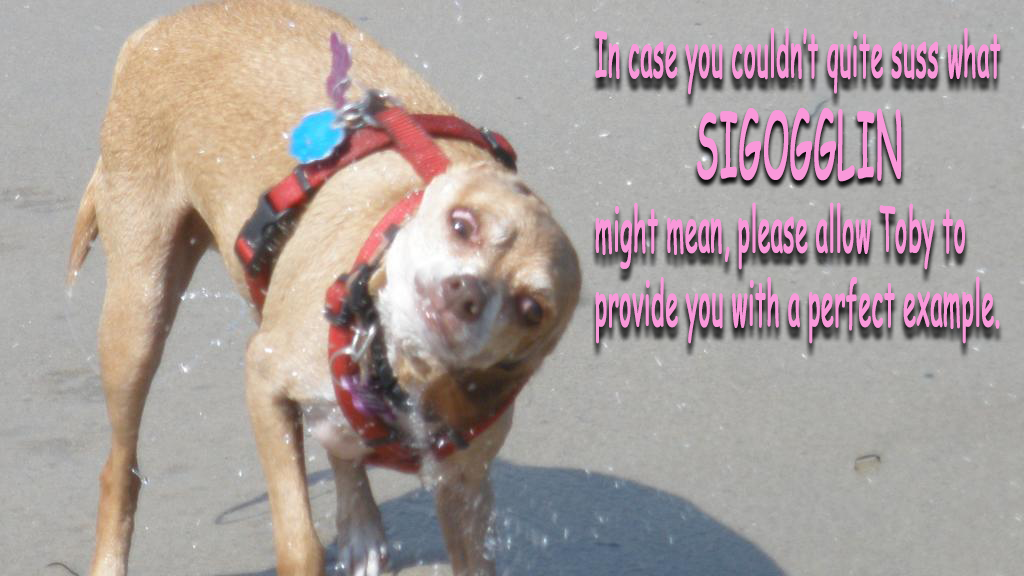
  • Sigogglin - wonky, crooked, out-of-whack
  • Sop - gravy
  • Swan (or Swannee) - swear, as in "I swannee!" usually said as you shake your head in dismay.
  • Toboggan - a toque, knit cap
  • Tote - to carry.  Also can mean a sack.  So you can tote a poke or tote a tote.
  • Tow sack - a big burlap bag
  • Yonder (Little Granny said "yander") - there, as in "over yonder."
Do you use any of these words?  If so, you may have been influenced by us crazy hill folk.

In case the word "sigogglin" just blew your mind, here's a fine example. Just look at that wonky face!


tinhuviel: (Default)

As I typed out the subject line of this post, it dawned on me that it's the title of a Culture Club song that was featured on the Electric Dreams soundtrack.

So I spied a post by someone lauding the beauty of Christian Love.  What exactly is that?  The entire post dripped of some misplaced spiritual superiority, as though Christian Love is better than your common, run-of-the-mill, lowly love.

The message I get from language like this drips of division and separatism.  I may be wrong, but I seem to remember that Jesus Christ was incredibly inclusive, especially considering the time and place of his activities.  Why his (fake) followers need to feel so special that they set themselves aside is beyond my limited comprehension.

Again, to echo the Culture Club song, love is love.  To give it any other designation is an insult to the very ideal of love, in my opinion.  And I'm not just speaking of Christians here, now.  Any sort of love, be it "romantic", "platonic", straight, gay, motherly, fatherly, sisterly, brother, etcetera, is simply and beautifully love.  And we are lucky if we ever feel it or are the recipient of it.  Many say God is love.  If that is the case, then the word "love" should be enough.  By its very nature, love is inclusive.  It is an invitation to trust and bond with one another, our fellow Earthlings, and our divine source.  To label it any other way is detrimental in every way.

And love is not just a word, obviously.  It is the expression of our deep connection, and we should act accordingly.  You cannot love, then set yourself apart from everyone else by defining the "type" of love you're feeling.  That behaviour is the very antithesis of what the phenomenon is about.  And, considering the behaviour of a lot of folks who claim to be Christian these days, many people who use the term Christian Love are doing their faith an incredible disservice.

tinhuviel: (Herne_Moon)

I got to thinking about this after reading a news story about a park ranger who got suspended without pay for refusing to kill two bear cubs. The reporter used the word "destroyed" when mentioning the mother bear. Such language diminishes the gravity of what happened to this bear. She had gotten in the habit of raiding a freezer full of salmon, so she was murdered. Plain and simple. Afterward, the media reduced her to an it that was "destroyed". You destroy buildings, you destroy works of art. These are things. Destroy is a word better suited to inanimate objects. The bear was not inanimate at the time of her murder. So, I bit the bullet and took the plunge into Change.org. Here's what I wrote, along with the video I added. Click the bear pic to go sign my petition, if you feel the call to do so.

Language matters. Language is how we exchange information and share common experiences. It helps to form our worldview and even how we see ourselves. It is also used as a tool of propaganda to sway the opinions of millions, a perfect example of which is its use by the Nazis, which resulted in the agony and death of countless millions more, either in the Holocaust or many battles of World War II. The language our officials and media outlets use when referring to non-human animal deaths at human hands is done so to keep us ignorant of, or complacent regarding the methods used to increase profits for industries dependent on such practice. Words like "destroy", "put to sleep", and "process" are examples of this. We are more comfortable with these words, because it paints over human complacency and disregard of other life on Earth. As long as we remain comfortable, however, the more lives will be lost. The media and government need to stop propagating such language when talking about our fellow Earthlings. The three aforementioned terms should be replaced with more accurate expressions of human/non-human lethal interaction, such as "murder" or "mass murder" instead of "destroy" or "population control", "euthanized" or "executed" instead of "put to sleep," (dependent on if the animal were ill and near death, or an inmate in a pound that engages in supposedly unwanted animal executions), and "slaughter" instead of "process." In just one generation, such changes would produce more empathy in humanity, not just for non-humans, but toward one another and toward the planet we all call home, as well. The sanitization of our language has blinded us to how brutal nature is and, indeed, how much more vicious we ourselves can be to everyone around us. Because of the shift of opinion based upon the language we use, we would take a longer time to decide to wage war or not be so complicit in the Prison Industry. By simply replacing a few little words with more accurate and honest ones, we could put ourselves on the road to a better and more sustainable way of life for all Earthlings.


So there you have it. If enough people sign the petition, hopefully it will bring the suffering we inflict on others to fore, and eventually make life on Earth better for everyone.

tinhuviel: (Shriekback Logo)

The band have posted an hour-long interview, answering fans' questions. Take a gander, and don't forget to pick up a copy of Without Real String or Fish.

tinhuviel: (RepLogo)

~Through Us the Way into the Sacred City~


~Through Us the Way into Nights of Heat and Weirdness~


~Through Us the Way to the Illuminated Ones~
logo1transparent.gif


~Sheer enthusiasm made Us~


~And Passion and Poems and Sex~


~Before Us nothing but Excellence can endure~


~For We are the Gateway to Excellence, Deviance, and Delight~
logo1transparent.gif


~ABANDON ALL MEDIOCRITY, YE WHO ENTER here!~


tinhuviel: (RepLogo)


Shriekback
The World’s Second Best Pop Group with a Bald Singer
By Dave Segal (‘Creem’ June 1987)

“…Shriekback have opted to make a different kind of music – one which exalts human frailty and the harmonious mess of nature over the simplistic reductions of our crude computers.” – liner notes to Big Night Music. This thing called Shriekback is a strange beast. Trying to describe them gives me one hell of a headache. The new Shriekback music (it’s called Big Night Music but it could just as easily be called Small Morning Music) screws with rock critics’ rote jargon. If you wanted to be crass, you could label ‘em an intellectual funk band with gospel/cocktail lounge pretensions. Unlike most Anglo-Caucasians who funk around with black styles of music, Shriekback throw a skewered light on what, in pedestrian hands, can be a brain-numbing genre. You can attribute Shriekback’s uniqueness (no lie) to keyboardist/singer/lyricist Barry Andrews.

Andrews has full control of Shriekback now that Carl Marsh has departed with his Fairlights and drum computers for solo obscurity. Pared down to a trio (Dave Allen, he of the Zeus-like bass playing on Gang of Four’s first two LPs, and Martyn Barker on percussion toys), Shriekback have for the most part ditched Marsh’s vision of a “harsh disco reality” and gone for a rococo/eclectic sonic gumbo that’s as slippery to grasp as Eno’s skull in a bathtub. There’s a slickness to the Andrews/Gavin MacKillop production on Big Night Music, but don’t let that trouble yer noggin. It’s a good kind of slickness; Andrews has a Byrne-Enoesque aesthetic that enables him to craft exotic pop of excessive fussiness (‘Black Light Trap,’ ‘Running on the Rocks,’ ‘Sticky Jazz’) or of severe sparseness (everything else). You could call this The Soft Album without too much controversy.

Oddly, some of the songs sound better with the volume turned down. Perhaps because he can’t sing very well, Andrews often resorts to an intimate whispery delivery. Very nice and relaxing, this voice. And he’s a clever gump, too. It’s not by accident that wispy, gentle toons sit cheek by jowl with swollen brassy epics; and then out of nowhere will sprout a pretension-deflater like ‘Pretty Little Things,’ which sounds like Prince on helium and dexies. I tell ya, listening to Big Night Music is more fun than working in an abattoir on a humid day.

Andrews has the serene monkish demeanor of the Keith Carradine character in the Kung Fu TV show. Before Shriekback, he was in XTC from ’77 to ’79, and he also played with Robert Fripp’s League of Gentlemen in 1980. He’s a peace-lovin’, broad-minded intellectual dabbler wearing a black floppy hat and a long black coat. We had a civilized chat amid the delicately bubbling jacuzzi water inside a swanky Detroit hotel. Andrews proved to be more stimulating than a week’s worth of The Dick Cavett Show.

CREEM: Why did Carl Marsh leave Shriekback?
BARRY ANDREWS: He wanted to do solo things, really. Carl’s quite a self-contained sort of bloke I don’t think he ever found it easy working with other people. The band was becoming a two-headed beast that was tearing itself in half. Oil and Gold (released in ’85) suffered from that. A bit of schizophrenia between the Carl direction and my direction. I like things when they’re soft and vulnerable and maybe even a bit maudlin. I like a certain amount of crying into my Guinness.

Did Marsh’s departure cause a change in your sound?
Definitely, there was a sort of opening of the sluices. When Carl left, I felt like, firstly, I’ve got this huge canvas to work with on the whole record. It’s all gonna be my words, my tunes. So instead of it being this common denominator area we could inhabit with Carl, what the three of us could agree on was actually a bigger area because there were fewer things to filter out. I wanted to try doing something very simple and direct and emotional, like ‘The Cradle Song,’ Just trying out every option and seeing what’s possible. There’s a certain amount of experimentation that doesn’t work, but a whole lot that does. Normally we wouldn’t have even dared to try. Big Night Music is diverse. I don’t think anyone could complain about it being too homogenous. I think there is a coherence to it that we’ve never achieved on a record before, with the possible exception of Care (released in ’82)

Does everyone have creative input into the words and music?
I’m the sole lyricist. On the new album, Dave confined himself to bass playing, Martyn did a whole lot more than he’s ever done. He plays all the drums and does lots of percussion. So he’s actually responsible for quite a lot of the textures. I’m really responsible for the way the whole thing sounds and the structure of the songs. I can’t imagine collaborating with someone on a song. It would be like having somebody advise you while you’re having sex with somebody (laughs). There’s so much that just happens in your head. It’s quite a fragile process and it’s not something I could easily involve someone with.

Your lyrics have a stream of consciousness to them…
A stream of unconsciousness…(much laughter).

Sometimes it’s brilliant and at other times it leaves the listener baffled. Maybe they’re too oblique for universal understanding.
Maybe that’s a valid criticism. I don’t go in for any kind of broad political commentary.

You write more about personal things?
I don’t know if they’re even personal things, really. What I try to do is create an entity with sound that has not existed before. The songs are meant to be things you can walk into and walk around, that have their own kind of smell and atmosphere and texture. They’re not meant to be billboards or television programs. Or newspapers. The lyrics aren’t the point any more than the bass drum pattern’s the point. You might have a very good pair of kidneys but that’s not your whole story, is it?

If I asked you what ‘The Reptiles and I’ is about, could you tell me?
I can tell you what I was trying to do. It’s what it is for you definitely. That’s a nice fatuous answer, I suppose, and it’s what it means to me. And that’s about as far as it goes. I had this idea of using a lot of lists that I found in Webster’s Dictionary. A list of languages, elements, proverbs. I liked the idea of a bunch of verses that were lists. I was trying to create a nursery rhyme that would work in an adult way and would have that sort of darkness about it, that sinister kind of thing that the best nursery rhymes have. I’m really a little kid sitting at the foot of the great god Language. I’ve really got no command over it. I pretty much take what it gives me. I get excited by all the different ways people speak in the same way. I get excited about all the different cultures people can have, all the different ways of being in the world. It seems very rich and diverse and brilliant. And it inspires me.

Were you influenced by any writers?
I steal a lot. I’m a complete bastard for that. I’ll tell you the dead ones. I’ve ripped Shakespeare off something rotten. I’ve had my way with T.S. Eliot. Martin Luther King. The Bible. Certainly bits of the Koran. Complete verbal beachcomber.

At least you’re taking from great sources.
Oh yeah. That’s what they’re there for. To get crunched up and recycled. I don’t do it in any cynical way. It’s like doing a cover of a band’s song that you really think is a good song. It seems silly to wrack your brains when somebody else’s said it so well. I just rip it off. Shameless, really.

Have any current songwriters influenced you?
David Byrne’s approach – when I was a bit more uncertain about writing lyrics – he seemed to offer quite a good little cubbyhole to hide in, where you could get away without saying anything at all as long as it sounded all right. But on this LP, I got less and less satisfied with what you could do with that and more interested in what would happen if you pushed the thing up toward the light a little more. So things like ‘Cradle Song,’ ‘Reptiles,’ and ‘Gunning for the Buddha’ are like little narratives, stories, which I’ve never attempted before. Getting into the old Tin Pan Alley thing. People like Gilbert and Sullivan and the English music hall singers. Popular Victorian kitsch. Edwardian parlor songs.

Shriekback is often labelled an intellectual band.
It’s high time we burst that bubble.

Are you college-educated?
No. It was between making a choice of being in a rock’n’roll band or going to university.

Are you religious?
I don’t belong to a religion. I don’t have any faith, in that way. I do have a strong religious sense. It’s difficult to say without it sounding pretentious. I have a sense of awe of a kind of religious veneration or worship in the presence of what is around – people, mainly, the rush and energy of people and what they can do and build and keep going on and having babies. Just what it is to be alive. There’s definitely a force that moves us on in a mysterious way. I said to someone once that I feel about religion the way I felt about sex when I was 12. You know there’s something going on, but you don’t know what the fuck it is!


To read more about Shriekback's music and career, please visit their website (sign up for the newsletter for free downloads) and Tumblr. You can also join in our conversations over on Facebook. And, while you're at it, pick up a copy of their new album, Without Real String or Fish!

tinhuviel: (Nemesis)
This track-by-track entry is on Shriekback's Tumblr.  If you have not already done so, click the album cover here to purchase Without Real String or Fish, so you can enjoy 'Beyond Metropolis' at your leisure!

no title

‘Without Real String or Fish’
Track by Track: ‘Beyond Metropolis’ (BA)


I often think about whatever alchemy of mind and circumstance it is that produces that elusive Last Track - the one that appears when the album seems to be over.  When you think you’ve mined whatever seam of compressed life-experience, obsession and influence-cluster it is that songs come from and you’re not exactly content but applying a sort of willed gratitude that, at least, it’s not all total shite, and - a baby miracle - another tune comes into being that you really didn’t expect and that seems to have, more than the others, a character that didn’t seem to have much to do with you (a bit like your children).

I find these are the ones I tend to listen to for fun the most. They’re more like someone else did them.  Past examples include Sticky Jazz, Coelacanth, Exquisite Corpse and Hubris. On this album we got two: Beyond Metropolis and Soft Estate.  Both voyaging into new territory: with BM an alt-funk anthem in an aircraft hangar with shards of space junk flying out of the darkness at you.

The chorus being a Bowie-esque, aching sunset of chords encouching word clusters of outrageous audacity. There is - gasp- even a key change (yeah we can do that muso shit if we want) and a key change back.

The groove upon which it was built was a thing I wrote a couple of years back, I had sent it to Carl but he hadn’t - as of last summer, when my ‘we are now finishing this fucking record if it kills me’ protocol was in full effect - come up with anything for it. I had booked Stuart Rowe for the mixing; we had enough tunes; Carl had 3 songs on the album; God was in his heaven and the sun was sporting a roguish titfer. Then..

..in his fearful aspect as the demiurge of deadline bending, Carl sent a roughie I couldn’t refuse. At a stroke, the mixing (which was to have been a stately affair of considered tweaking and contemplative strolls around the elegant parterres and formal gardens of the Lighterthief estate) turned into the usual Shriekback panicked scramble as we struggled to bring the prodigal Beyond Metropolis to the same stage of development as its siblings.

Not to do so would have been unthinkable, of course: it had the word: ’Enchromosoniradiopolis’, fer crissakes.  The heart bows down.

Barry Andrews
19 March, 2015

tinhuviel: (Thy Mama)
BioLuminescenceThu_423

Lambent [lam-buh nt]


  1. Running or moving lightly over a surface: lambent tongues of flame.

  2. Dealing lightly and gracefully with a subject; brilliantly playful: lambent wit.

  3. Softly bright or radiant: a lambent light.

Origin: Latin  (stem of lambÄ“ns) lapping, present participle of lambere to lick wash (said of water or fire); akin to lap

tinhuviel: (PSA)

English is the only language I can fluently speak, and even that is debateable. I know bits and bobs of other languages, including Mandarin, Welsh, German, Yiddish, Russian, Polish, and Xhosa. But there is this one language whose intricacies I began learning at a very early age. That would be Sarcasm. When it comes to Sarcasm, it really doesn’t matter what your native tongue is; rather, it’s more to do with body posture, inflection of the words, even the tone of voice that makes for a successfully delivered dollop of linguistic malice.

I began learning Sarcasm at the tender age of nine. It had been going on three years since my parental units’ divorce and, even though I was well taken care of and had no doubt that I was loved by Granny and Aunt Tudi, I still missed that connection kids apparently enjoy, regardless of culture or location. I would write them letters, and be thrilled when they wrote me back.

If they wrote me back.

One day, Aunt Tudi and Granny took me to Woolworth’s so I could spend some of my allowance money. Instead of getting a little toy, or candy, or whatever a kid with a couple of bucks could buy back in 1976, I bought two identical greeting cards. After not hearing from either Unit for quite some time when I saw these cards, it was my first crash course in the wonderful world of Snark.

Even though I was hellbent on mailing them to the Mother and Father Units, Aunt Tudi convinced me not to do it. I kept the cards, though, up until I finally disposed of them in the late 90s, because they were yellow and tattered with age. The message was ingenious, though, and I kind of wish I’d held on to them, just for shits and giggles. I’ve recreated the card here, for the enjoyment of any and all.


Very simple, to the point, and unmerciful – like all good sarcasm should be.

tinhuviel: (Ornate Triskele)
This isn't showing on Amazon, yet, so I'm sharing it here as well.

I've long held the opinion that oral traditions were not entirely dependent on repeatedly telling the tale and memorizing every nuance that the story contained.  I am of a mind that there comes a point where spoken and written communication becomes embedded in cultural and racial consciousness.  Even if you've never heard a song or a tale before, sometimes you still recognise it.  Something within you resonates with an ineffable sense of truth that, to quote Obi-Wan Kenobi in Star Wars, "surrounds and binds" you. More often than not, such transcendental familiarity can be associated with a person's ancestry.  You are experiencing a kind of sacred sentience that scientists, particularly in the field of genetics, are only now coming to understand.

This expansive consciousness is not limited to humanity.  It involves everything we think we know, and emanates far beyond the boundaries we have yet to imagine.  Our fellow Earthlings perceive existence in ways so alien to us, we can't even grasp the enormity of such a concept.  The more we learn about the world around us, the more obvious it becomes that our knowledge and understanding don't even skim the surface of the mysteries of creation.  One thing we have begun to accept, though, is the power of DNA. Within DNA rest infinite spirals of information that can be accessed as needed and enhanced by the epiphanies their current vessels' experience in their lifetime.  Looking at it from this perspective gives rise to the idea that sentience doesn't reside within us; rather, we reside in sentience. Everything we know, or think we know, has been discovered countless times before, and will continue to do so as the universe, or multiverse, seeks its own definition.

What does all of this have to do with The Augury of Gideon?  Everything.

First, the definition of "augury" as found on Dictionary.com:

augurydef


A great deal of the books of Daniel and Revelation are auguries in the Abrahamic religions.  Many Shamans, from the ancient past to the present, are augers, their knowledge, often acquired by rote, are auguries.  Some auguries are so old, their wisdom have become organic, inscribed upon the very atoms that comprise the spirals of DNA.  An augury can be quantum graffiti, the wall upon which it is written, creation's tabula rasa, eternally craving the to be filled with poetry, whale song, the repetitive patterns drafted in the path of stars and the whispered constructs of a virus.  It is known and understood on innumerable levels and in dimensions that may never be proven by humanity.

That said, an augury can be anything, not just a spoken tale or a series of letters chiseled into stone.  Pull away the veils that conceal its stories, and it will be revealed in an infinity of forms.  It can be the symphony of what will come, encrypted and replicated in every tiny cell that makes you you.

I first encountered the word "augury" when I watched Earth: Final Conflict in 1997.  One of the main characters, played by the brilliant Richard Chevolleau, had the nickname "Augur," which he acquired because of his almost supernatural computer skills, which included hacking and virtual linguistic gymnastics that helped the resistance better understand the true intentions of the alien Taelons.  Being a student of the prophecy, omens, and various forms of divination, I instantly loved the word and mentally bookmarked it for possible use in the future.  I got my chance two years later while I was writing Cadmus Pariah's biography, Sui Generis, which became one of the chapters in the first Relics book, The Chalice.  I started the story out with a strange little phrase that had been looping in my mind for days:  "The desert shakes with the footsteps of the Jinn, ascending for the perishing sun, owl and serpent alike."  After completing the bio, I attributed what looked to be a prophecy to one of the Original Ten Vampires, a Tarmian wood-worker, who became known as Gideon. The name was based on a bit of confusion on my part, at the age of 9.  In 1978, I watched an old Jack Benny movie called The Horn Blows at Midnight.  Mr. Benny played an avenging angel whose duty was to sound his trumpet to herald Armageddon.  I don't know how or why it happened, but up until I gave the Tarmian-turned-Upyr the name, I had always thought Jack Benny's name in the film was Gideon. Even though I discovered I was mistaken, I still kept the name.

During the time I was writing Sui Generis, I was learning more about Shamanism and the use of hallucinogens in various Shamanic rituals around the world.  Ever since I'd learned Syd Barrett's tragic story, I became resolute in the opinion that by way of LSD, Syd became hyper-aware of how vast and incomprehensible reality truly is and, because he apparently had little or no training in Shamanism, he was unable to process that which had manifested, and it drove him mad.

I could easily see that as a possibility, considering the presence of the archetypal mad man or fool making itself known in cultures throughout the world over the span of millennia.  Two modern examples of this would be the character of Gabby Johnson in Blazing Saddles, and Matthew Silver, who is a performance artist in New York.  He's the perfect modern example of the archetypal mad shaman.  Watch him in action, and you'll see what I mean.


So, taking the components of a Gene Roddenberry sci-fi show, a case of mistaken identity involving an old B&W film from the 40s, the tragic story of Syd Barrett, the theories of cellular and racial memory, combined with cosmic consciousness, I added the Fool archetype, and anchored the character to Dean Haglund in his role as Ringo in The Lone Gunmen to further flesh Gideon  out.

Gideon was the mad Vampire shaman, and his prophecies were known to exist by the entire Hive, but no one knew what all of them were.  No one could say if they came in the form of scrolls or were passed on in oral traditions.  His foretellings were collectively called The Augury, and it is this that became the third Relic, which was actually seen and held by at least two characters in the first Relics book, The Chalice. Even though Gideon is seen only in retrospect throughout the series, he and his message became two of the most important factors in resolving the arc story.

About half of the book was influenced by a song called 'Planet' by Shriekback, a bonus track on the now impossible-to-find "Cormorant" egg. I don't know what the true meaning of the song is; rather, I wrote a large portion of The Augury of Gideon based on my interpretation of the lyrics.  It certainly triggered thoughts of martyrdom and sacrifice in my mind, with some unexpected results.

As is expected, the final book of the trilogy brings a few storylines to close, and says goodbye to some of the Vampires at its end.  Given that The Augury is firmly based in the cyclic nature of existence, the immortality of genetic memory, and the indestructibility of sentience, I would suggest you compare the last story to one of Cadmus' favourite things:  a black hole.  Going into a black hole may very well seal your doom, based on what we think we know about how the universe works, but it could also be a tool of cosmic transformation, giving credence to the Pagan concept of the Goddess' womb to tomb aspect.  Who knows what may happen when you come out the other side of the black hole?

Perhaps we can find out together.  Until then, I hope you enjoy this book and the characters that told the story.  If anything in any of the three books inspires you to learn more about some of the concepts, traditions, cultures, music, and philosophies that helped inspire them, then I'd say my work is done.  You have the secrets of The Augury now.  It's time to pass it on to others.

tinhuviel: (Torquemada)
Why do movies portray non-English speakers as speaking English, but with the accents of the land they are from? What does the English or American accent sound like spoken in Russian?

For instance, I am watching this movie Vlad and it stars two Americans who are supposed to be Romanians, but they are speaking English in what is supposed to be their own country. I know it's so the viewing audience can understand it, but how does that work exactly?

It's like Cloris Leachman said in History of the World, Part 1, "We are so poor, we do not even have a language! Just this stupid accent!"
tinhuviel: (Barry Exact Science)
Squid
Crepuscular
Weasel
Pox
Innumerable
Luminescence
Velvet
Cheetah
Peripheral
Parthenogenesis (of course!)

There's plenty more, but these are at the forefront of my headmeats right now. Feel free to add to the list with your own favourites. Let's have a language party!
tinhuviel: (Judge Judy)
If I ever get rich enough, I'm buying the Rosetta Stone courses for Russian, Czech, Polish, Scots-Gaelic, Cymru, Cantonese, Japanese, Spanish, and Swahili. Or, as Barry would put it, I'd want to learn "Hindi and Sinhalese, Spanish and Japanese, Afrikaans, Nepali, Faroese, Romany, Yiddish and English, Kurdish and Thai," plus the aforementioned and maybe even a few more. I want to learn them all. I want to be the "I" to all the Reptiles, at least in terms of language.

I used to know a good bit of German and French. And I taught myself a hell of a lot of Russian. Now, I can't even read the Cyrillic alphabet, which shames me deeply. I'm a prime example of the adage "if you don't use it, you lose it." But I can still sing "Give My Regards to Broadway" in Polish, although I doubt that'll ever come in handy, and I can even sing a few choice Mouth Music tunes in Scots-Gaelic. I have no interest in Spanish, but knowing at least a modicum of it in America has fast become a requirement in this day in age.

I guess what I'm trying to say is that I'm far from Reptile status. Woe is I.
tinhuviel: (Default)
Oh Goddess help me, I'm in so much trouble!  There's this crazy German woman at work who complains about everything to me in a thick, scary German accent.  I could balance myself on my right pinky finger as I juggled Grade A blunts with my toes whilst singing the Goards' version of "Gin and Juice" and waving a German flag betwixt my teeth, and this woman would still find fault in my efforts.

Until today.

Today, she found within herself an ounce of kindness and opened the front door for me as I struggled with my hand cart, which was filled to capacity with 30 24-pack cases of 24 ounce soft drinks.  As I scooted my way through the doorway, I smiled at her and said "vielen dank!"  I expected her to say "bitte" or some sort of something like that but, instead, she grinned really big and said, "Oh, you speak German!"

"Well, only a little," I replied.  "I've forgotten a lot of it and I'm really really rusty at it."  I shrugged, hoping that'd be the end of it.

It wasn't.  The crazy German lady beamed with joy and said, "Well, we'll just have to teach you, yes?"

So I'm polishing up on my ultimate German phrase:  "Ich verstehen nicht!"

I do not understand!

Lady deliver me from crazy Germans.

As it stands right now, I need to learn three languages:  German, Spanish, and sign language.  I can barely speak and write English.
  Pathetic I am.  Pathetic and horrified.
tinhuviel: (Tingrin)
The "traditional" term is Creature of Habit, but I have decreed that, in the South, we only have Critters of Habit. This epiphany came to me when Aunt Tudi was telling me about Motley's daily ritual of coming in around lunchtime, eating a buttload of food until her belly looks like a baseball, and then lying down on the orange couch to take a several hour nap. I proclaimed that Motley was indeed a Critter of Habit. Now, if she were a cat living in Brooklyn, she'd be a Creature of Habit. But she's not a Brooklyn cat, although she'd do well in Brooklyn, I think. Motley is a little ruffian and could definitely hold her own with the city cats in the alleyways.

But she's a Southern cat, which means she's not a wise-ass alley cat, but a hell-raisin' Redneck cat. And she's a Critter of Habit.

This summons up my feelings about the South and being Southern. Before the Internet, I was profoundly ashamed of my heritage, so much so that I've almost totally eradicated my accent. I sound nothing like the other members of my family on the Father Unit's side. The Mother Unit's fam is bit harder to pin down. G'Pa was born in England, but lived most of his life in NYC, or so I believe. I could be wrong on this. The Grandmother Unit was born in SC, but escaped to NYC at a very young age and never came back, living there and California for the majority of her life. Both of them globe-trotted, being musicians and Bohemians.

Being Southern in the US means that you're automatically judged as an inbred idiot with no education. At least that's how I saw it and, honestly, I was led to see it that way because of the US media's treatment of the South. I've told people over the years that I'm a product of the New South, that generation that schluffed off our Old South albatross, masked our accents, and stressed the fact that we were contemporary and educated. It's a ruse, of course. I've come to realise that one can still be educated and have a horrific Southern accent. I'm doing my best to deprogram myself and not think "idiot" every time I hear a Southern accent.

I say "a" Southern accent because there's more than one. Sometimes I think that non-Southerners believe that there's only one accent, much like a lot of Americans think that there's only one British accent. Not true. In fact, accents can vary drastically within just 100 miles. The Western North Carolina accent isn't as "thick" as the South Carolina Upstate accent. We in WNC don't trill our "r" when saying "three," but SC Upstaters do. We say "flim" for phlegm, but Upstaters say "fleem." A lot of people in this area call Yvonne "WHY-vonne," whereas she's simply Yvonne in NC. In the South Carolina Low Country, the traditional accent is a lot like what you hear on TV, where it's assumed that all Southerners pronounce Southern like "Suthun." No. That's pretty much a Low Country and coastal Georgian phenomenon to my knowledge. Bostonians and Charlestonians say "park the car" a lot alike. They know no 'r's in their language.

Anyway, I digress. As I was saying, before the Internet, I despised being Southern. Now, not so much. Being exposed to so much diversity has made me realise how precious diversity truly is, including my own unique spot on this Earth. I can get away with saying "critter" and I now say it with relish. I enjoy the fact that nothing here is big; rather, it has to be big ole. My ability to tap into my Inner Southern has become a prideful thing to me. The method of Southern expression is sometimes the only way to describe a thing, and only a true born and bred Southerner can describe it in the way it needs to be.

I got a hint of this while working with Timothy, who is Southern through-and-through. He explained to me that dogs don't have fights; instead, they "waller down a bunch of ground." And you don't take up a gun and shoot a deer; instead, you "throw up and cut down" on it. Very descriptive, very accurate, and these expressions can not be uttered with anything but a Southern accent. Tim is one of the smartest human beings I know, and he's one of the biggest Rednecks I know, too. At the time, I would look down my multi-cultural New South nose, and tell him that I would never say such a thing. Now? Yeah, I probably would, simply because I'm one of few who really can.

So, to quote a former co-worker, "I said all that to say this:" my cats are all Critters of Habit. To be honest, so am I. Yee haaaaah!
tinhuviel: (Quoi?)
Yesterday we had a pot roast and invited Llew over for a nosh. Today Aunt Tudi is feeding the cats beef fat. I keep telling her that cats don't eat cow, they're too big. All cats can do with cows is nibble at their hooves and get kicked in the head for their trouble. When I told Aunt Tudi this, I realised that I can't say "hoof" without emulating the way Patsy Stone says it in the "Morroco" episode of Absolutely Fabulous. Edina is telling Saffy that the Moors didn't have toilet paper before the more "civilised" Brits came to enlighten them. She asked Saffy: "Do you know what they used before we came?" (that's paraphrased....I may be incorrect in the quote) And then Patsy piped up and said: "Old bits of hoof." That's pronounced hooooof, long "o," not huhff. Ever since, I say hoooooof, long "o."

It's like the word "speed." I have to say it with a French accent, like "speeeedddddddd," thanks to Eddie Izzard. [livejournal.com profile] clumsycake is in the same boat. We get together and talk about the movie Speed and we sound like a couple of Parisian whores.

In other news, [livejournal.com profile] das_prompt was good enough to announce the confirmation of the existence of bootlegging primates. This reminds me of a show I saw back in the late 70s. It was a National Geographic show on PBS (pre-Cable for you whippersnappers) about the inhabitants of the African Savannah. During the wet and fertile season, all the animals (both predator and prey) would gather at the water hole to enjoy having water. The trees around the water hole would have fruit that had fermented on the branch. All the herbivores and omnivores would partake of this fruit and have a drunken party while the carnivores would roll around in the water and essentially laugh at them all. I'm not lying. I clearly remember seeing inebriated giraffes and monkeys yucking it up together. If there'd been a tattoo parlour around, these critters would have gotten inked. All in all, it was a feelgood moment for all the animals, and the only time they all got along before going back to killing, being killed, and feuding over water rights. Bornean apes apparently don't have to worry about waiting until the right season when the fruit will ferment in the trees. They make their own brew and raise their own roofs.

February 2019

M T W T F S S
     123
45678910
11121314151617
181920 21222324
25262728   

Syndicate

RSS Atom

Popular

Page generated Jan. 8th, 2026 05:43 am